Of Milong Tagalog, Indian Mangos, and Covid
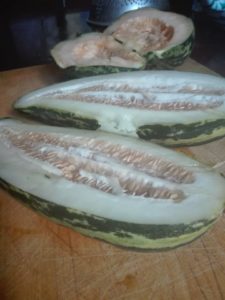
Muskmelon. Milon Tagalog in my language. Murod in Ilocano
Today, on my way home from Walmart, I saw a roadside fruit stand selling Milon Tagalog and “Indian” mangoes. Milon Tagalog (a variety of cantaloupe) has a citrus-like taste, similar to cucumber. With its mushy texture, it has always been served as a refreshing drink in summer, made by mashing them, adding water, evaporated milk, sugar, and ice cubes. Like many other kids, I wasn’t really a fan, wishing we could afford Milon Kastila — the sweet and aromatic muskmelon. However, as I grew older, I began to appreciate this Milon Tagalog.

Milon Tagalog summer refreshment
When buying Milon Tagalog or Murod, opt for the malabo variety — one with a mushy, sticky texture, which is the perfect choice for that refreshing summer drink I described here. For Tagalogs like me, or Ilocanos out there, I bet they know what I am talking about. To determine if the milon is perfectly ripe, select those with burst skin or cracks caused by moisture. As the melon ripens, the skin splits, allowing you to see the flesh and the seeds. They’re the best. I got two kilos of the Milon Tagalog, which my cook can prepare as a refreshment. Yes, she’s back for the nth time, but that’s another story.
The fruit vendor had a lot of Indian mangoes to sell. You know the type as opposed to Apol Mango. Search me, but I don’t know the origin of the names. I used to think that Indian mangos originated from India. I never bothered to ask. A novelty in the 60s because they were new in the market. My grandfather only had the piko and carabao varieties. Much later, people in my neighborhood began cultivating them, finding them everywhere, and no one seems to care about them. The novelty has faded. The taste and the smell remind you of kerosene. I know what kerosene smells like, but the taste?, I like them, though — those indian mangoes, not the kerosene. I prefer the green ones, but those that are crunchy, manibalang as we say; green bordering on ripe. I used to like sour green mangoes, especially when dipped in bagoong (anchovy sauce), but I can no longer eat them, the tart green mangoes. The bagoong, yes, any time!
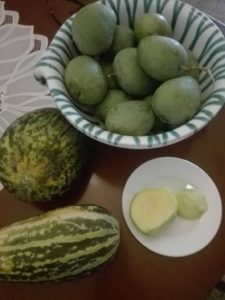
Milong Tagalog (Tagalog melon) and Indian mangoes
The Apol (apple) mango, on the other hand, which I would bet the Pinoys invented the name because of the fruit’s appearance — reddish skin like an apple’s. I can get them in Vienna supermarkets, imported from. Brazil or any other Latin American country. The Mangos from Brazil, as they are called in Vienna. Does anyone remember the movie The Boys from Brazil? The title may lead you to think it’s porn, but sorry to disappoint my gay friends; it is not. It is a thriller novel by American writer Ira Levin, and it was made into a movie with the same title. Get yourself a copy.
I told the fruit vendor that I don’t like sour mangoes. No, they are not, she assured me. And I prefer them manibalang. Yes, sir, promise, she was quick to reply, so I got two kilos of them. I sighed because, on a happier occasion, I could get them from our Mayor’s front yard —the Indian mangoes, baskets of them at times, and all for free. I was drooling when I got home and asked my cook to peel one for me. With salt? She asked. Yes, with salt. They’re not yellowish at all, well, a bit of yellowish, but not the yellowish I crave. Oh, never mind. I had one bite, and my face was the most corrugated face you can ever imagine.
“Shit, ang asim! “(so sour!) the mangos I mean, but my face, too. I cannot eat them, the mangos. Indian mangos are the only green mangos I can eat because when slightly ripe, they are not as sour, unlike the carabao mangos that can stimulate my head skin pores to open, making my head and whatever is left of my hair wet. Those Indian mangoes I got fell short of my expectations.
Whatever sympathy I had earlier for the fruit vendor turned into rage. Well, a bit of it. I told her I was surprised that she sells fruits on the roadside. The coronavirus Lockdown forbids trading on the roadside.
“When you go hungry, you don’t listen to prohibitions,” she said. The produce she sells was from their farm. They have a lot, and they cannot sell them. Their farm, where they grow them, is in another town, and therefore, they cannot bring them to the market in my hometown. Last week, much of their harvest went to waste when it started to rot. And next week their watermelons are ripe for the pickin’, but they don’t know what to do now. Whatever they can harvest, they sell at the roadside at the risk of getting caught and fined.
Don’t you get financial help from the local government for your loss? I asked. No, they don’t. I am sure they will get compensated, but of course, it’s wishful thinking. I hope they will from the relevant authorities.
Now I am worried that the talk about chaos this pandemic may bring could become a reality when people are hungry and there is nothing to eat. You cannot eat Milon Tagalog and Indian mangos every day. They, too, will become so expensive that people with little or no money cannot afford them. I can only think of scary movies like that helicopter scenario in the Broadway production of Miss Saigon, when the American Embassy was evacuating people. We already know that the helicopter could only take a handful, leaving a bunch of Vietnamese scared and crying at the gates.
I was reminded of this heartbreaking scene when the Austrian Foreign Ministry, during the coronavirus outbreak, sent a message to all Austrian citizens in the Philippines, asking them to register if they wished to repatriate to Austria. Holding an Austrian passport, I registered and received a call asking if I wanted to join a repatriation flight on March 30. The message sounded urgent, which worried me.
I then quickly realized that they are doing this in case of an emergency. And also for those Austrians stranded in a country with a virus outbreak. Still, I decided to stay until my original booking date.
All individuals arriving at Vienna Airport are required to undergo a mandatory 14-day quarantine. Like many other Austrians, I live in an apartment in Vienna—a condo, they call them in the Philippines—and I must stay in my flat until the house arrest is over.
Where I live in the Philippines, I have a huge garden with fruit trees and bougainvilleas. I can always step out of the house, and immediately, I am in communion with nature without having to go beyond the gates of my property. I am free to move around, hardly noticing that the Lockdown could be over. So I am staying, hoping for the best, expecting the worst. Bahala na (Come what may) as we, Pinoys, are quick to say when faced with a crisis like this one. Lilipas din yan (it will pass).
Bahala na. Que sera, sera!
So many things to be grateful for, Badik. At least you have an option. Forgive na the fruit vendor for trying to make a living. Let the rest of the Indian mangoes ripen. Keep safe. I hope Walter is ok in Vienna.
Forgiven and forgotten na. :) Dropped by her roadside fruit stand today to get more Tagalog milon. She told me that there was this rumour that the palengke, pharmacies, groceries, etc. will close starting April 1 so she’s worried. Told her that it’s not gonna happen. Our Mayor has not said anything about that. Also, it’s on April 1, come on! True enough, our mayor, in a message today said that it was just another fake news. Some people can be so irresponsible
You made the right decision to stay. At least you are in mansion with your huge garden around, unlike in Vienna when you are “imprisoned” in an apartment for days.
I know. I’ll go nuts but not Koko-nut hahaha