Friends and Classmates Lost and Found
I’ve got a new friend. She is Sitang. No, not the Sitang famous for the cuchinta and other rice cakes she makes and sells in our town’s palengke (market) in Plaridel, Bulacan. The cuchinta Sitang was my childhood friend and classmate from Grade School. She is single. This new Sitang, a widow, is also from the same town. Still, I did not know her until Bebe, a classmate of mine and Cuchinta Sitang’s, introduced us to each other on a summer day two years ago. We’ve been buddies since then—to my astonishment.
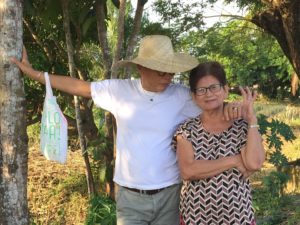
Sitang and I
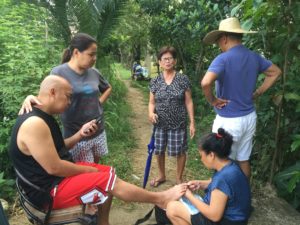
Sitang (with umbrella) lining up for a foot service at 7 a.m at the Patubig dirt road in her village
It was my new hobby of collecting rare bougainvillea varieties that brought us together. Bebe, whose house is a few meters away from mine, told me she knew someone who had a bougainvillea garden and asked if I’d like to see it, so I said, “Okay, take me there.” The garden is in the next village, but she did not know exactly where. Bebe has a friend who does. That was Sitang; she can show us the place. This visit to the bougainvillea garden not only introduced me to a new friend but also sparked a shared interest that has since become a significant part of our friendship. “No need to call her, we can go straight to her house and pick her up,” Bebe was confident. And if she was not home, what then? I asked. She would be, Bebe insisted, she knew it. Indeed! Sitang immediately came out of the house when she recognized Bebe’s voice. “Get in the car, and’ll tell you why we’re here,” Bebe said again. Once Sitang was inside, a sudden, disgusting smell that was unmistakably rotten fish took over. I had to open all the car windows to eliminate the repulsive odor.
Her booming voice, when she spoke, was a surprise. It was naturally loud, a hawker’s—one that could bring the dead to life, really, but one gets used to it in the long run. She explained that she helps her daughter prepare homemade foods every day to sell for a profit. Customers are mostly students attending the school located just across the street from the house where the daughter lives. That students were getting squids and galungong that day I met her for the first time. That was long ago when galungong was known as the poor man’s viand because it was the most affordable fish available. Now they’re more expensive than our national fish—the milkfish—at 240 pesos a kilo. And now everybody is proud to admit that they have galungong on the table. Suddenly, the lowly galungong has become a symbol of wealth. According to my cook, our cats won’t settle for anything less than galungong, and she was not exaggerating. I bought silinyasi (sardine-like fish or tawilis) one day for our four cats (not counting the several stray cats in our backyard that my cousin would feed, as she thinks she is Mother Theresa and my house is her convent). A kg of galungong won’t be enough. “I told you they don’t like them,” that was my cook. She was right. Is that so? Let them starve then! My bubble thoughts.
I did not find any new variety of bougies in the garden. Still, since it was already past lunchtime, I felt obligated to buy Bebe and Sitang lunch for going out of their way to help. I suggested that we go have lunch at Max’s—the restaurant with the famous slogan they have been running since I can remember: ‘Max’s, the house that chicken built.’ My treat, I said.
“Oh, I stink!” Sitang vehemently refused to join us. She wouldn’t be caught dining at Max’s, by far the most decent restaurant there is near where we live, in her smelly dress. I insisted that she come with us. By lunchtime, I was already used to her fishy smell. One gets immune to the sights, sounds, and smells of everything around you after a while, so in my case, it didn’t matter to me if Sitang took a shower or changed clothes.
Call Lita, I said. She lives nearby, and it would be nice if she could join us as well. Lita was my roommate in Manila back in the ’70s, when I was seventeen and still in college. We lost touch after I received my diploma and had not seen Lita for more than 40 years, until one day when Bebe came to my place with a friend who happened to be Lita. Like Sitang, Lita was their classmate in grade school. Fate was kind that Lita and I would meet again!
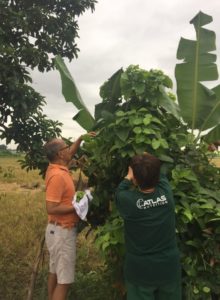
Picking alagao leaves with Sitang in the early morning along the Patubig road
Sitang’s mobile rang while we were having lunch. It was a friend she was supposed to meet at the time of the call, but it slipped Sitang’s mind. She excused herself to leave, but I told her to invite her friend for coffee. The caller was another classmate of theirs—they don’t run out of classmates, it seemed to me at the time, classmates I might know, like this one. True enough, she happened to be my classmate in High School—a classmate I had not seen or heard from since 1962, when she quit school. She was Inga to us in HS, but Sitang and company refer to her as Angie, so it didn’t occur to me that she was the same person on the line. “Angie,” Sitang said to Bebe and Lita, in a hushed voice that was almost a whisper
“Meet Angie, our classmate in grade school,” Sitang said to me. “This is Badik, a friend of Bebe and Lita’s.” The name sounds familiar, she said. Yes, she remembered she had a classmate in HS with that name, but she could not reconcile the similarities. No, you can’t. That was like a century ago, my Dear! Usually, you would get a number to schedule a meeting with me.
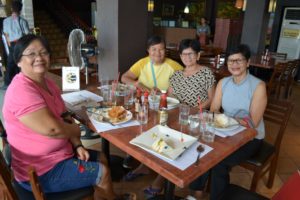
Inga (in pink shirt) with Bebe, Sitang, and Lita at Max’s (The House that Chicken Built) Pulilan
“Inga, Inga, been a long time!” I was ecstatic and hugged her.
“Angie actually,” she said, a finger on her pursed lips to hush me. I frowned. Yes, she is now Angie to everyone. What happened? Things happen when you are not looking.
“Angie,” she would remind me every time I’d say Inga to her. I was getting annoyed, and I could hardly hide it, when I told her that Inga is a beautiful Scandinavian name. Beautiful in Scandinavia, maybe, but not when you are in the Philippines, where names like Petra, Kulasa, Primitiva, and, of course, Inga, can sound offensive to Filipino ears. Primitiva, really? Search me, but why would a parent give a child that name? But, yes, what’s in a name? There’s so much in a name—Shakespeare, believe me—especially when you are a Filipino. Ask Inga!
You will always be Inga or Dominga to me, just as I will always be Badik to you and to everyone else in my village. I have moved past the teenage stage when I hated that nickname, so get over it. Her friends told me that she changed her nickname to Angie when she got a bit rich, lending money for profit. The name Inga didn’t have a pleasant ring to the ears, so Angie it had to be.
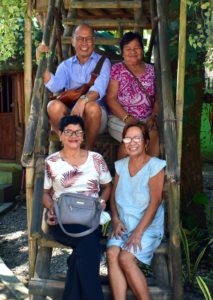
Meeting Linda (seated, R.) for the first time many years later after our HS graduation in 1969. Beside her is Lita. Bebe beside me
Linda was another classmate in HS. She was sweet sixteen the last time I saw her, on stage, in 1965, when our Class sang our Graduation Farewell Song. We never saw each other again until 2017, when both of us were in our late 60s. Bebe knew that Linda and I belonged to the Class of ’65 from the same HS. I’d wanted to see her since. She said she could arrange a meeting with her if I’d like to. That would be lovely, I agreed.
With my baseball cap, she didn’t recognize me immediately. Let me take off my hat then.
“Kalbo! “(bald!) she cried out, making the word sound like it was the most obscene word ever invented.
“Bitch!” my alter ego was struggling hard to keep calm. I managed a weak smile.
“Di ka pa rin nagbago! Bata mo pang tingnan, kalbo nga lang.” (You haven’t changed a bit: still looking young, but bald). I said, despite flashing a toothy smile.
“Bitch! Bitch! Bitch! “my alter ego again.
Running her fingers through her hair, she apologized for her looks. Had she only known we were coming. She then ran a hand over her so-called duster dress. I remember her as the girl in HS who was very particular about her looks. Her school uniform was always crisply starched and pressed; her hair was teased, resembling a beehive.
We mostly talked about our classmates and our much-hated School Director—a nun who was extremely mean and strict to us, her students, but one who, quoting a friend, had a Mary Magdalene complex. She could not decide if she would be a saint or a whore whenever Father Baltazar was near her.
Linda is not a whore; never was and never has been. But she has become an overnight saint, ironically, after abandoning her Catholic upbringing, against which she has a lot to say. Her faith is now much resilient, she claims. She is now “enlightened,” not hiding her contempt for those who remain in the dark.
Sitang does not hide her contempt for what to her is Linda’s ever-shifting religious state of mind, which can be Catholic one day and enlightened the next. “Kung saan ang ihip ng hangin, “(wherever the wind blows), was how she described it. A practicing Catholic, Sitang recites the rosary (imaginary?) even during her daily short morning brisk walk along the Patubig (irrigation canal) in her village. She would stop walking—and praying—every time she bumps into someone she knows, for a chat or the latest gossip—the imaginary rosary beads dangling from her hand. I have yet to see the rosary.
It was not rosary beads she had in her hands last time I saw her at the Patubig, but a small ube root crop (purple winged yam), the size and shape of a ping-pong ball, her ying-yang ball, I assumed. She can give me more, she said, not to soothe my nerves, but to ask my gardener to cultivate in my garden. That my gardener should plant the crop in the dark of the night. She saw me frowning, so she explained to me the theory that ube (purple) root crops, when planted during the day, would yield a crop that is pale or white, as opposed to deep purple. I smiled, realizing that Sitang, like me, was from another generation. This generation still believes and follows to the letter what our parents and grandparents taught us, no matter how weird they may have sounded to us then, now ridiculous to the Millennials.
We always find an excuse to get together—all of us now in our 70s, still finding time to laugh together, enjoying life while it lasts. I appreciate their company, and I hope they do mine. I may one day learn to give in and call Inga a name she likes to please her. Any name, but Angie. As my truce offering, I’ll call her Dominga—her Christian name.
And Linda? Mary M.
https://waterfallmagazine.com
Great blog! Is your theme custom made or did you download it from somewhere?
A theme like yours with a few simple adjustements would really make my blog
stand out. Please let me know where you got your design. Thanks
a lot
Custom made. I was frustrated the first time I worked on it though but finally managed.:) Thanks for noticing.