The Day Tradition Died
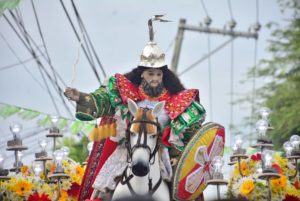 SALUBONG is a Tagalog word I have always associated with St. James, the Apostle, better known as Santiago Apostol to Plarideleños—the people of my hometown, Plaridel, in Bulacan Province. Santiago Apostol is our town’s patron saint, the star of the show held on December 29 of each year. It is the start of a two-day town fiesta in his honor—the day when parishioners and devotees from my town and other places as far as Manila dress up in native costumes to fetch the image of Santiago Apostol from his residence in a little village in Plaridel. The home is called Sipat, where he is housed year-round, except from December 29 to the second Sunday of January. Next to Jesus Christ, he takes center stage in our town’s parish church.
Salubong is a Plaridel tradition of deep cultural significance. It evokes fond childhood memories of December 29, when our mother would take my elder brother and me to town. We would stand at a specific corner of the street, eagerly awaiting the arrival of the float carrying the image of Santiago Apostol perched on a white horse.
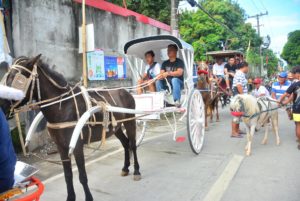
Spearheading the entourage would be equestrians, tilburies, and calesas (buggies) specially decorated with buntings for the occasion, trailed by older women, such as grandmothers, dressed in colorful native costumes and dancing to the music of marching brass bands. Like the other kids, my brother and I would jaw-drop, mesmerized by the sight of dancing horses. That was a treat we always looked forward to at that time of the year. My brother and I would go home, each with paper mache horses sold at the church entrance, tucked in our underarms. Oh, the tears I would shed inside the church when my beautiful balloon, bought by my mother for me, would get loose from my grip five minutes or so after she paid for it, floating on the church ceiling, joining other balloons that had slipped from the hands of other kids. I cried because I was not getting another one. My fault—my mother would remind me. She told me to wait until the misa (holy mass service) was over before getting a balloon, but I would not listen. I would end up with a stiff neck, looking up at the ceiling, during the mass in Latin—a special holy mass called misa cantata that took forever to end. To a young boy like me, it was just theatrical, with actors like the cura parocco in his best Sunday “dress” as the leading man, and the bevy of other priests as the supporting cast. These priests were of lesser significance, I deemed. If they were of the same rank as the cura, why would they do the “dirty” job for him—handing him everything he needed, turning the pages of the holy book, even so that he could read them?
Thoughts of a young boy, tired and bored, whining the whole time, soaked in sweat because the church was packed with devotees; it was burning hot. The shrill voices of women sínging Kyrie Eleison would jolt me, torturing me big time. But, of course, I was talking about the frustrated-town sopranos—Aling Enyang and her understudy, Chitang. Chitang who? I thought I saw women in the pew, rosary beads dangling from their hands, exchanging a knowing look, then sharing careless whispers. Rest in eternal peace, Aling Enyang and Chitang. Kyrie Eleison on you.
Across the street from the church was the local Perya (fair), which I cherished much because of the childhood treats waiting for me—the Ferris wheel ride, the choo-choo train, and the traveling circus featuring clowns, little people, and human oddities like babies who never seem to grow or get old despite their beard stubs. While I never enjoyed the sight of babies advertised as duendes (goblins), the clowns amused me no end. There would be games like beto-beto (I realized much later that it meant bet, oh, bet, oh!), a perya game of dice in a small saucer covered by another small saucer. Numbers were inscribed on the beto-beto table for gamblers like me to place their bet. I don’t remember the game’s mechanics. I remember that the beto-beto guy—the operator—would shake the saucers with the dice inside. When he releases the dice on the table, there will be winners. I would always lose. I remember the boiled apulids (water chestnuts) you eat after peeling off the black skin—a tedious task. You end up with your teeth dotted with tiny black specks that were the apulid skin. I remember the popcorn, the nilagang mani (boiled peanuts cum shell), and the pink, red, and yellow sugar cotton candy. Childhood treats, indeed!
The feast day of Santiago Apostol would only be complete with the serenata held in the open air in the town plaza. It is usually a competition between two marching bands that, on the night of December 29, would outdo each other for about an hour, showcasing their skills by playing brass instruments before a crowded audience. The serenata is a celebration of music, community, and the fiesta spirit. It is a time when the community comes together to enjoy the talents of the marching bands and the festive atmosphere of the plaza. Then, against my mother and aunt’s knowledge, I would slip out of the house and meet other kids, like my cousins, from the neighborhood. Together, we would head on foot to the plaza where the serenata was happening. The serenata was one highlight of the fiesta I tried not to miss, risking my mother’s wrath and fury when she found out. I only had to ask her permission, she would say. But, of course, the answer would be a firm No, anyway, so why bother?
Another highlight of my childhood’s Salubong celebration was the crowning of Plaridel’s Fiesta Queen on December 30. She was the girl who sold the most tickets in the competition, a testament to her popularity and influence in the community. Her role as the Fiesta Queen was not just a title; it was a responsibility to represent the values and spirit of the fiesta. Her crowning was a celebration of her achievement and a reflection of the community’s crucial support and active participation in the fiesta, a tradition we must all strive to preserve.
On the second Sunday of January, the devotees of Santiago Apostol gather once again at the church plaza to bring him back to his permanent home in Sipat until it is time for the next Salubong. Hatid (deliver), on the other hand, is the time when Santiago returns to his permanent residence. Unlike the Salubong, the Hatid offers less pomp and pageantry, but it would still be a celebration. Over the years, there would be fewer and fewer equestrians, horse-drawn tilburies, and specially decorated calesas like those used to have in the Salubongs and Hatids of my childhood. Still, there will always be devotees to keep Santiago Apostol company when he goes home. I am now in my seventies, and so are many of my childhood friends in the neighborhood, who used to get excited when it was Salubong time. Some of them are no longer alive, such as the Salubong tradition we once knew so well.
The tradition has long gone. The last time I witnessed a Salubong procession was when I was home from abroad for a Christmas break, long before I retired. I was standing at the corner of a busy street where my mother used to drag my brother and me. I was again that little boy squeezing his way through the crowd, trying to get to the forefront for a better view of the float carrying the image of Santiago Apostol—with equestrians and tilburies spearheading the procession. Trailing them would be women in native costumes, dancing to the music of a marching band. Motorists were not allowed to enter the main road. The last time I observed the Salubong, I remember feeling disappointed when I saw fewer equestrians, horses, and calesas. They were becoming extinct, disappearing from the tradition we, children, have always associated with this festival.
At my age, when big crowds and noise can quickly drive me to distraction, I have, sadly to admit, stopped taking part in the Salubong. However, a friend who lives in the same city abroad as I do tries to come home every year for this festival. It is her panata (devotion) to our patron saint. She confirmed what I already knew—that the Salubong tradition had lost much of its magic.
The Salubong is no longer the one I remember from childhood. Equestrians, horses, tilburies, and calesas are getting rare. Instead, tricycles and motorbikes are taking over. I’d rather have a few horsemen, horses, tilburies, and calesas than have Peter Fonda-wannabes—daredevils—perched on their bikes. They create severe noise pollution and burn gaseous fuels, thereby contributing to climate change.
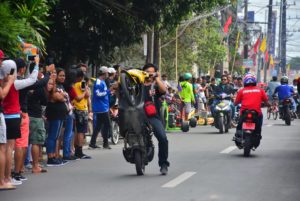
A young motorbike rider, when asked by a spectator to refrain from running his motorbike in full blast, replied that a motorbike has always been a part of the tradition. Hello? Since when? For three years, maybe? One local town official in my hometown said we could not forbid people from riding on motorbikes during the Salubong; it is a fundamental human right. A human right, my foot! Have we seen people riding on bikes during the Quiapo fiesta, where the divine image of Jesus of Nazarene is brought out of its shrine for a procession? Jeez! It would be a sacrilege! Likewise, motorbikes are not allowed when Pulilan, Bulacan, observes its annual carabao festival in May. Try and scare the living lights out of this beast of burden! Why can’t we maintain ours? We can do it sans motorbikes.
The issue may not be the municipal government’s responsibility, but it can still discuss the problem with the church’s management. Let’s not forget that the local government’s constituents are also church parishioners, who, like me, would be happy to keep the Salubong tradition going, minus the noise that tricycles and motorbikes make. Let us keep the tradition alive, solemn, and meaningful, as it was intended to be.
Paging the attention of the Parish priest of Plaridel, Bulacan.
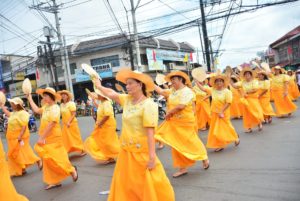 On a happy note, we still have enough women folks and devotees keeping the tradition alive and kicking with their traditional dancing. But for how long? Marching bands would rather play techno music so the dancing lolas (grandmothers) can hardly keep up with the rhythm. By the way, are marching bands getting irrelevant?
Sighs!