Tales from the Bo. Fiesta in Vienna
“It has been quite a long time since I ate biko, halo-halo, ginatan, and palitaw.” That was my very dear friend Cynthia on the other end of the phone, deliriously excited about the delicacies she expected to find at the Barrio Fiesta festival in Vienna, which was taking place that weekend she would be in town. So she traveled 461 kilometers from Dornbirn, a city in the Austrian Alps where she lives with her husband and son, to have a massive bite of those Filipino food specialties. These dishes, deeply rooted in our culture, are not just food but a representation of our traditions and history. Biko, for instance, is a sweet rice cake often served during special occasions, symbolizing prosperity and unity. Halo-halo, a popular dessert, reflects our love for variety and creativity. Ginatan and palitaw, on the other hand, are traditional snacks that evoke a sense of nostalgia and comfort.
If I would go with her, she asked. I said I had gout acting up, so I might not; otherwise, I would ask my other friends who regularly attend the annual festival if they don’t mind her tagging along with them. The heatwave was another excuse to save me from the agony— in my case, that was the Bo. Fiesta. A big, noisy crowd repels me, something I never had an issue with when I was young or younger. Who would have thought I would be the image of that person complaining about noise and crowded places? I’d been listening to music or watching television at home, with the volume set to the lowest level, and I could hardly hear the sound. We all know that Filipinos generally cannot hold silent conversations. “Why do you have to shout? “This was a question my Austrian friends frequently ask me when they hear Filipinos talking to each other, especially in a group. Many of us are hard of hearing, would be my defensive reply. Bakit nga ba? (Why indeed?) We are excitable people, plain and simple.
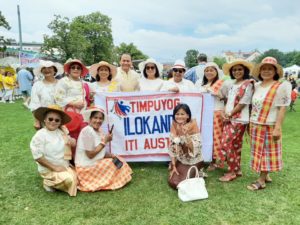
Olive and the Ilocandia Family in Vienna
There was intermittent rain that day of the Barrio Fiesta, but we had umbrellas, so the rain did not stop us from going. Since it wasn’t a particularly hot day, I decided to go with Cynthia. The festival was located on the outskirts of town, so we took the train to get there. We could hear different Filipino languages (I couldn’t understand them, hence I call them languages) during the whole ride —reminding me of the confusion of tongues in a biblical story. If only my Austrian friends could hear them now. I was a wreck when we got off the train. A considerable crowd of Pinoys was getting off the train—all headed to one destination. I noticed the perplexed look on people’s faces who were unaware of what was happening.
“This was supposed to be fun!” I said to Cynthia with a hint of sarcasm. “I’ll have my biko and ginatan and palitaw, and we’re good, I promise,” was her quick, mischievous response. It never happened. We stayed until it was almost time for the participating Pinoy Associations in Austria to fold down tents.
We can hear loud music from a distance and smell grilled meat and fish, specifically mackerel. That Pinoys have a penchant for grilled mackerels is a puzzle to me. I could not, and I still cannot, develop a taste for this fish. Give me galungong at any time! That was wishful thinking, not with my frequent bouts of gout.
The fiesta was in full swing when we arrived. Cynthia, I could tell, was awed by all the frenzy going on and did not waste time searching for the goodies she hoped to get. We stopped at practically every food stall— and there were hundreds of them— to check out what they had to offer: More barbecue and grilled mackerel. There was fried daing na bangus (sundried milkfish) in halves that sold for, guess what? Yes, Virginia, €5 apiece! I went broke; I don’t care, and I ordered a set with rice and a drink, as written on a piece of paper hanging on the tablecloth, right below where the bangus was on display.
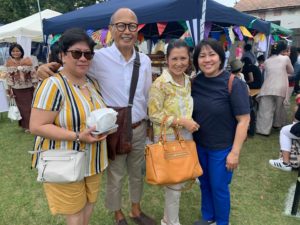
Fancy meeting at the Bo. Fiesta, the sisters Monina (extreme left ) and Jeannie (absolute right). My good friend Cynthia was in a yellow floral blouse and traveled 561 km. from Dornbirn to Vienna for the rice cakes she hoped to find at the fiesta.
“No, Sir,” said the girl serving the food when I pointed at the fish head. “The whole bangus fish head does not come with rice and drinks.” She showed me another food warmer containing grilled mackerel. Underneath were fried bangus cut into quarters. “That was the set, Sir, for €5. The fish head costs €5, too,” she explained.
“Five euros for a fish head? You must be kidding! ” I told the girl behind the counter. Suddenly, I lost my appetite and left.
“You can stick it up yours,” I wanted to tell her. I saw the disappointed look on the girl’s face, as if she could read my mind and say, “I would if I could, but I already have five fish heads up mine, Sir!”
Cynthia found her puto and halu halo at the next stall, but did not get them. “We’ll come back,” she said, repeating the same line to every booth we stopped by to look at until she was convinced that the biko she was getting was up to her liking.
Moving from one food stall to the next was difficult without bumping into someone you met a hundred years ago, and you go, “You look familiar, but I could not place you!” And then the other person told you the same until it dawned on you that she was the boy you were dating in your late 20s, until you decided you had had enough of his halitosis. Or was it his athlete’s foot?
“Moren, Moren!” I blurted out when I thought I saw another familiar face. Moren is one of the Pinoy friseurs in Vienna. But, of course, he is bakla! (gay). I last saw him a few years ago. He did not react when I called his name. “Moren! It’s me!” I was yelling for him not to hear. It was not Moren. It was someone I recognized when she turned her head. “I am not Moren. I am Shirley, Beth’s former babysitter, don’t you remember?” And I was, “Oh, what happened to you? I thought you were Moren!” Talk of adding insult to injury!
After walking around a hectare of an open square for the nth time, checking out every booth that may be selling Pinoy rice cakes, and occasionally stopping for an animated chat or selfie/groupie photos with friends and Bekannte (acquaintances), I was about to drop dead. It was almost 3 p.m., and we’d been scouring the place from 11 in the morning! Cynthia had yet to decide which sweet stuff she saw for the nth time could pass for pede na (it will do). Finally, she said she would make another round. I should wait for her at the Ilocandia tent, where I had a great time catching up with my good Ilocano friends, like Manang Flor and her sisters, Olive and Heide. I’ve known them for a long time, in Sampaloc, a district of Metro Manila. They were family to me. It was like yesterday once more.
Grace, Manang Flor’s eldest daughter, was there too. She spoke out loud about her disappointment with many Ilocandia members who had left the group due to some petty issue and had formed their own.
At the Ilocandia tent, I found precious ampalaya (bitter gourd) leaves. Unlike most Pinoys who prefer to add the leaves to their ginisang mongo (sauteed soya beans), I thought of Hokkaido pumpkin pureed with chunks of codfish. At the Barrio Fiesta, ampalaya leaves weighing less than half a kilo were selling for— you bet again!— €5! Go broke was my motto of the day, and with that in mind, I said to myself, “Go get them!” My friend Olive —the erstwhile President of the Ilocandia Group in Vienna — was, as always, generosity incarnate, giving me some ampalaya fruits for a song.
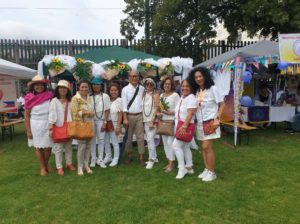
Former colleagues from work and some other acquaintances I haven’t seen for years
At the Ilocandia tent, I found precious ampalaya (bitter gourd) leaves. Unlike most Pinoys who prefer to add the leaves to their ginisang mongo (sauteed soya beans), I thought of Hokkaido pumpkin pureed with chunks of codfish. At the Barrio Fiesta, ampalaya leaves weighing less than half a kilo were selling for— you bet again!— €5! Go broke was my motto of the day, and with that in mind, I said to myself, “Go get them!” My friend Olive —the erstwhile President of the Ilocandia Group in Vienna — was, as always, generosity incarnate, giving me some ampalaya fruits for a song.
The tent next to the Ilocandia’s was selling patola, a type of gourd, but not the bitter kind. A plastic bag containing five very young patolas that had yet to grow big to qualify as pede na, which is what I needed them for, was yours at €5! What I needed them for was open to interpretation, but truth be told, I needed them for my Miki noodles (fresh noodles). Unfortunately, I cannot get fresh noodles here, but I can settle for fresh fettuccine. Improvise! I improvise and use okra when I run out of lube. Go organic, Tante Teresita— a big fan of everything organic—tells us all the time. She believes everything a vendor tells her when she buys vegetables or meat.
Cynthia returned to the Ilocandia tent shortly before the downpour. She was eating halu halo. To those who have yet to have it, halu halo is a concoction of shaved ice, evaporated milk, and root crops. She also had a bagful of rice cakes like puto cuchinta, suman sa lihiya, and puto pandan. She swooned over the biko she had just had before the halu halo. So if you have an Ad Agency and are looking for a person who can be a living testimonial for biko, get Cynthia.
That evening at my place, she had them again for dessert. She woke up the next day with tooth pain, which didn’t go away until she was back in Dornbirn, where she had her big tooth pulled out by her dentist. “No more rice cakes for you?” I asked. On the contrary, she always has a sweet tooth until the very last one is gone.
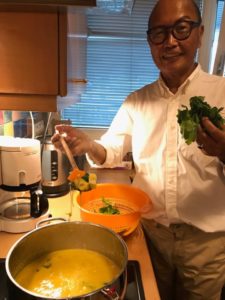
My most coveted treasure from the Bo. Fiesta: bitter gourd, aka ampalaya leaves. They lend a distinct flavor to my pureed Hokkaido pumpkin.
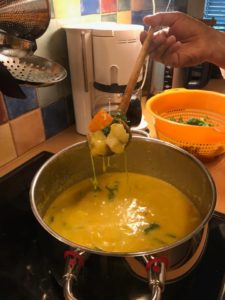
I prefer my pureed Hokkaido pumpkin with chunks of cod fish.