Of Pancit Alanganin, Sinuso, Dinuguan and Putong Polo
“Tito, alam mo ba ang alanganing pancit? ” Joyce, the eldest daughter of Ana, a friend and former Mayor of my hometown, asked me while we were having dinner at her mom’s house, if I knew about pancit (noodles) that is not really pancit, yet it is still considered pancit — my rough interpretation. My spoon stopped in midair, in suspended animation, my left eyebrow arched sky-high on its own. She burst out laughing at my reaction.
I know there is baklang alimango, but baklang pancit? Come on! There was no such thing as baklang alimango until some Dummkopft thought it funny (funnymyass!) to describe this unique crab as such, and the name stuck.
Baklang alimango (gay crab), in my childhood, was called luno (soft, weak), apparently because of its inherent characteristic—soft-shelled, hence luno. A bakla is supposed to be luno, weak. Those who define bakla as such may visit a leather gay bar for the surprise of their life. If you are one of them, don’t forget to carry a lube with you, should you get lost in the darkroom. You may be in for a rough ride, which can make you think twice before you say bakla next time you see a soft-shelled alimango.
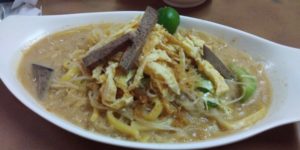
Pancit Alanganin
Pancit Alanganin is a mix of egg noodles and bihon (rice noodles) stewed with a hint of milk, making it soupy, unlike the regular pancit bihon, which is typically cooked to a dry consistency. It is neither this nor that; hence, alanganin —undeniably not al dente; it was soft and soggy.
Joyce wanted to introduce me to this pancit. It is very famous in Bocaue, a town in my province, that people from neighboring towns drive even in soaring temperatures to this eatery, which the owner confidently calls a restaurant. It was super hot that day we had our food trip. The restaurant was located in the silong (ground floor or underground) and was crowded with guests, despite the unbearable heat. Two ceiling fans were blowing hot air. The resto may have started as a canteen catering to students from a nearby private school. It was probably the only place considered “cool” at that time for young students to meet with their peers during class breaks, or even after school while waiting for their yayas or the chauffeur-driven family car.
“You can also have Sinuso (sucked), Joyce again. I think I choked.
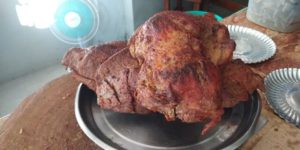
Sinuso (deep-fried pig’s mammary gland)
Sinuso is a deep-fried mammary gland—a pig’s mammary gland. Suso is Tagalog for tits, while Sinuso is the past tense for the suckling act. Gross graphic description, I know, but since when is suckling tits considered gross? The day you stopped being an infant? I know that many men, as well as women, never quit.
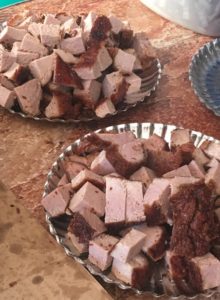 Joyce bought 2 kg of Sinuso. “Fry them,” she suggested, “that’s how I remember my Dad liked them.” Good for breakfast, her mom told me. I went home with my share of Sinuso. Breakfast time, and I had a spoonful of them—and stopped after a spoonful. No more fried mammary gland in fried rice for me, please. Must have been my imagination. Wyatt, my transient boarder, liked Sinuso. Again, I say different strokes for different folks.
“We’ll have dinuguan (blood stew) in Marilao. Very good with their putong Polo. Joyce again, her eyes glowing with animation, talking about our next stop.
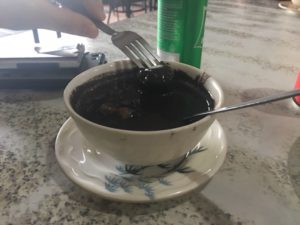
Dinuguan (pork blood stew)
Marilao is another town in Bulacan, located next to Bocaue, if you are traveling southbound. It was our next stop—another restaurant/carinderia, offering the best dinuguan in town and equally famous for its rice cakes called putong Polo. (rice cakes) Polo was a town until it became part of Metro Manila and is now called Valenzuela City. It borders Marilao, and its claim to fame is Putong Polo.
“I can have the puto, you can have the dinuguan,” I wanted to say. Dinuguan is not recommended for individuals with high uric acid levels. I am one of those people. I wasn’t risking another gout attack by eating dinuguan. I had pancit palabok instead, another type of noodle dish with shrimp gravy. Even this could trigger a gout attack, but I was taking the risk. In the end, I could not resist soaking my puto in the blood stew. I woke up the next day feeling the pain in my left foot. Oh, the beautiful things I can live without! Never mind, who cares anyway for dinuguan on a sizzling day like that day in a carinderia/resto in flame? I can try again in December, when I return home.
——————
Sometime later, I realized I had made a wrong description of Baklang Alimango, as pointed out by a good friend—a foodie—who brought to my attention that soft-shelled alimango (luno) and Baklang Alimango are two different crabs. “The baklang alimango is more fleshy, with yellowish taba (crab roe)—a delicacy in safran color, and rich in flavor, used in many culinary dishes. The shape of this unique crab’s “apron” or flap is a characteristic that is between patusok (pointed) and malapad (wide).” As in accurate Beki fashion—gay lingo for bakla— the baklang alimango must stand out from the crowd, generally very particular about its physical appearance, and loves perfection. This humorous misunderstanding about Baklang Alimango added a light-hearted touch to our culinary adventure.

My friends and I are doing the food trip
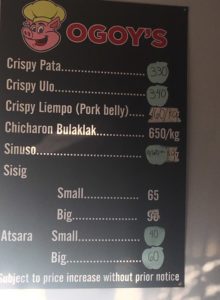
The permanent menu
Please bring some putong polo Dik. Puti and brown. I miss those. But these days they make them very small. Perfect with butter!
They make them very small, correct. Will bring you some para maging super cindy ka na uli :)