A Birthday Story*
“Oh, what I would give to be 40 again!” I said to a friend who recently turned 40. He wished he were 20, prompting me to ponder the seriousness of my wish, given the highlights of the day when I hit the big 40. Remembering that day still makes me shiver!
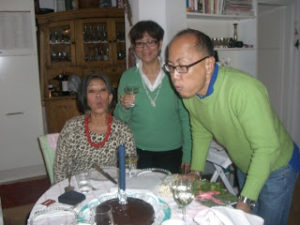
My 60th, with Tante Teresita at her place, and Chuchi, another friend in Vienna.
Walter, my Viennese friend, surprised me with a train ticket to Prague, where I needed a tourist visa to visit. The Czech visa, not stamped in my passport, was issued on a separate piece of paper. I had never been to Prague, and Walter thought it would be a sweet birthday treat to take me there. That was a long, long time ago. I try to forget, but in vain.
I remember the day we arrived in Prague. It was wet, cold, and grey — quite depressing, I must say. Our hotel was ostensibly one of the best in town, but do not be impressed, as this was when the East was still red. We were required to leave our passports and visa documents at reception until our departure — standard hotel procedure, we’ve been told.
Another birthday celebration. Prost!
As I strolled through the streets of Prague, I couldn’t help but notice the many Asian artists selling their paintings. Most of them were from Vietnam, participating in an exchange student program. It was a stark contrast to the familiar sight of Filipinos, whose presence in even the most remote corners of the world is quite remarkable, thanks to our Diaspora of Filipino domestic helpers. At that time, Czechoslovakia was still a communist country and not a potential market for our labor export. But times have changed, and the presence of Filipinos living and working in Prague today would not be surprising.
It was drizzling the next day, and it was still grey when we went out to lunch. Not a single Filipino to be found, but the Vietnamese students in their army-surplus jackets were there where we last saw them selling paintings. A long queue of people caught my attention — the soup line. I was shocked to know that this was happening, especially in Europe, never mind that this was in a communist country. The scenario reminded me of Oliver Twist — the original black-and-white movie version. My sympathy went out especially to those very young children freezing in the cold, waiting patiently for perhaps their first meal of the day.
At the train station on the way back to Vienna, Walter asked again if I had my visa. The passport, I said, but not the permit. I did not expect to need it for the return trip, since the hotel reception did not return it to me. The train was about to leave — the last ride for Vienna that day. Walter was worried, but he said that hopefully, the Czech inspector would not ask. At the Austrian-Czech border, the train stopped for passport control. Three border police officers with fierce-looking German shepherds on leashes asked where my visa was. Walter explained why I didn’t have it, but they would not listen. The police officers told me to gather my luggage and get off the train. Walter tried to assure me that everything would be fine. Instead, I felt like a criminal being escorted to jail while passengers looked at me from their windows. I turned my head just in time to catch a glimpse of the train leaving. I could see Austria from a short distance. Freedom was just a glance away, so near and yet so far. Suddenly, I was afraid.
They interrogated me for what felt like an eternity at the train station. They screamed at me and treated me like a criminal. I tried to explain in English and German, but they refused to speak in a language I could understand. Finally, they handed me a form with instructions in the language they expected me to decipher. I didn’t have a pen, and they wouldn’t provide one. I was getting frustrated, tired, and edgy, and I lost control of myself; I exploded and was no longer afraid. I told them in German that it wasn’t my fault that I didn’t have my visa and that I would appreciate it very much if they could show some compassion and tell me what to do. Finally, one of the officers who had been flipping my passport stood up and, in fluent German, said to me that since it was my birthday that day, they would grant my wish. He said they would call the hotel to verify my visa. Otherwise, I would need to go back to Prague and go to the police headquarters and explain how I lost my permit. I was hoping against hope that the hotel would have my visa. But, of course, it wasn’t there; they told after the police made the call. It was only 4 p.m., and the next train to Prague was not due until 6 p.m. This experience, though harrowing, taught me resilience and the importance of keeping a cool head in difficult situations.
After buying my train ticket, I asked the police officers for a place to get a drink. They gestured to a pub at the train station. The pub was filled with locals and clouded with cigarette smoke. I had to stand for a while to get a better view of the surroundings. Everyone’s gaze was fixed on the door, where I stood in a long winter coat and Stetson hat, holding a fake Louis Vuitton travel bag — of course, made in China. Despite the situation, I couldn’t help but find the scene amusing. It felt like a scene from one of those old black-and-white silent movies. Or better yet, from Casablanca — with Bogart in his classic raincoat, hat tilted on one side of his head, cigarette dangling leisurely between his lips, entering a bar lounge. But, of course, I couldn’t pass for Bogart; I could try Charlie Chan.
Once my view of the room cleared, I walked to an empty table covered with a filthy cloth, covered with cigarette ashes, and looking like soil. I hesitated to sit down until the waitress came up and, with one swift stroke, lifted and flogged the tablecloth, creating a swishing sound. Now free of dirt, she put it back on the table, stretched it flat — upside down.
Sitting at the following table were the three border police officers who had just interrogated me, drinking beer. They appeared friendlier this time, smiling and raising their glasses to me as they proposed a toast. I gestured for them to join me at my table, which they did. I said it was my birthday and asked if I could buy them a drink (hoping against hope that they would just let me go back to Austria). I felt embarrassed when they admired my suit and necktie, which they said must be expensive. A western cut, maybe, but no, it was not fancy, I said. They asked me about the places stamped on my passport, which they only knew by names, and told me how lucky I was to have a good job that enabled me to travel to faraway countries. It got melodramatic when they confided to me that their meager salaries could not provide a comfortable life for their families and that their children could not have the beautiful clothes and toys that children on my side of the world might have. Since it was my birthday, I told them I wanted to do something good and offered each of them 100 Austrian Schillings (about 7 Euros), which was already a significant sum. For the children, I said. They refused the offer, telling me that it was kind of me, but buying them a glass of beer was kind enough. Oh, no! You have no idea! Get the money and let me free, I wanted to say.
They kept me company until it was time for me to go. Then, they volunteered to carry my bag to the train station. Hmm, they were, in fact, friendly, I told myself. One of the officers helped me find a vacant seat while the other two stayed on the ground — with their German shepherds. When I shook his hand to say goodbye, he asked me shyly, and in a whisper, if the money offer was still valid. He could not accept it, he said, in the presence of his colleagues, as it would look like he was taking a bribe. And with that, he wished me good luck in Prague and hoped to see me again sometime. In your dreams, I wanted to say.
I arrived in Prague very late in the evening, went straight to the reception, and asked about my visa. They have it! Are you kidding me? “I called earlier to ask, and you said you didn’t have it?” I wanted to scream at him, which I didn’t, of course, knowing they could make my life miserable than it had already been since being detained at the border. Instead, I went to the bar and ordered a glass of beer. I noticed the presence of several sweet-painted ladies — seated at one corner of the lounge, some of them excitedly giggling while comparing notes, I presumed. I saw one looking at the lady with contempt. The lady didn’t waste much time; she grabbed a stool and asked in English if I was Japanese, to which I replied, “Yes!” She told me she was a university student, 18 years old, and asked if I would buy her a drink. She said the beer would be excellent and thanked me with a wet peck on the cheek for my kindness when the beer arrived. She wanted to know about my room. Search me, but I had no idea why she cared to know!
“Single bed, and very narrow, indeed!” I tried to discourage her if she had no place to spend the night. I was sure that was her intention. That I snore would be a good alibi had she insisted. After a second beer, she said she needed to use the powder room and would be back soon. Once she was gone, the lady with a sneer came up to me and asked how old I thought the other girl was. She said she was eighteen, I said. “Eighteen, my foot!” As if I cared. “She’s ancient; she’s 28!” She was full of contempt.
“She’s disgusting, isn’t she?” I gasped, mocking surprise while struggling to stifle a burst of laughter. Someone save me from her, please!
I bought her a drink. She was thirsty, she said. Japanese, I said when she asked about my nationality. I might as well be consistent with my lying, which only made her more interested in me. Tokyo, she has heard, is a very crowded and expensive city. I said that I come from a small village miles away from Tokyo, so I’ve never been to Tokyo. If only my mother could hear me! She would pray the rosary to save my soul from eternal damnation. For lying too much!
Meanwhile, a group of five young men arrived, probably in their 30s, and sat opposite us on the other side of the bar. As I learned later, they spoke Swiss German and were there on business. Seeing my company, they immediately dabbled in excited conversation, exchanging naughty remarks, just like the boys in my high school class would whenever the new young teacher entered our classroom in her mini-skirt. I turned my head when I noticed them looking over my shoulder. My original GRO was back from her trip to the powder room –her cheekbones suddenly made more prominent by a generous dab of blush-on powder, lips neon-light. She was standing behind me and was not amused to see that I was not alone. I could tell right away that Three’s Company was not her favorite TV sitcom. An argument ensued immediately between her and my redeemer.
I speak German and can understand some Swiss German. I laughed when it dawned on our Swiss audience that I understood them because of a particularly hilarious remark they made about the escalating catfight. I didn’t want to lie when asked about my place of birth. Hearing what I just said that I was from the Philippines, the girls, as if on cue, stopped bickering. The one with the sneer looked at me as if sizing me up, left in haste while mumbling some incoherent words –expletives, I bet you –but I caught some that sounded like the Philippines. Marcos! Huh? The other one was at least honest enough to tell me what she thought of the Philippines: A country of poor people living in the slums. That having said, she offered a handshake, thanked me for the beer, and wished me a pleasant stay in Prague. For the kind treatment I received, I felt deeply indebted to the mass media, especially television, for consistently producing excellent documentaries that showcase what they consider the only exciting subject about my country — poverty.
Oh, look who’s talking! I felt the urge to retaliate. I have yet to see a soup line in Manila! But that would not change the image of the Philippines planted in her brain. I needed a more potent drink to calm me down. A shot of vodka did it. I raised my glass to the Swiss and greeted them the Swiss way — Gute mitenand’. They, too, were having vodka. They asked me to join them, and we ordered more vodka. We were getting louder, our speech slurring as we emptied one bottle after another — the episode of the poor people living in the slums soon forgotten. The vodka was chilled to perfection and cheap, so we were drinking it like water.
The last bottle, though, tasted like water. So, of course, it was water! The barman insisted that it was indeed vodka he had served us, but later relented, saying he had made a mistake when prodded to taste it himself. He feigned surprise and immediately dashed into the back room, where he presumably stored his supplies. We could hear him and his staff laughing hysterically. They must have thought that we were too intoxicated to notice the difference. He was back in no time to tell us there was no more vodka left and apologized for giving us the bottle of water they kept in the same fridge as the bottles of vodka. Hello? They were still laughing when we left.
I woke up the next day, shortly before lunch, with a light headache and was starving, having gone without food the previous night. I went to the restaurant and ordered steak with French fries on the side from a tiny boy who could not even be older than thirteen, I thought. He was doing his apprenticeship as a waiter in the hotel. When he returned with the food, he was with an elderly guy in a hotel uniform. He was the headwaiter. He told the boy to give me fries from a serving plate down to mine. The boy had difficulties keeping the serving spoon and fork clamped together in his delicate little hand to catch the fries. Finally, the headwaiter took over and demonstrated how to the embarrassed tiny apprentice.
“Now, do it yourself,“ he yelled. The scared little boy looked at me with a restrained smile before giving it another try. His upper lip was by then glistening with tiny pearls of sweat, his hand noticeably unsteady. A few pieces of fries slipped out of the grip of the serving spoon and fork, some landing on my plate, the rest on the table. Furious now, the headwaiter grabbed the silver utensils from the poor boy’s hand, scooped the fries from my dinner plate back to the serving plate, and told him to do it again. I pulled the plate away from the hand of the young fellow and slammed it on the table. Both of them froze. I no longer cared whether he could do it. I did not care for French fries either. I was starving and worried I might miss my train if this went on forever. My steak was getting cold — the sauce turning into lard.
I finally made it to Vienna. I did not see the border police who scared the living daylights out of me. They may not be on duty, but I wasn’t keen on seeing them again. Nineteen years later, the memory of them dragging me out of the train with their evil-looking German shepherds still haunts me to this day. I always wonder what happened to that tiny hotel restaurant apprentice. I wonder if he survived the ordeal or ever recovered from the horror of serving French fries ever.
_________________
*Published by Philippines Graphic, May 12, 2008
What a captivating experience! It felt like straight out of a spy novel. Glad you made it back Dik!
i would have been a novelty for the pinoy tourists, with my statue in brass, and with caption: one too many vodka :)
I could still remember when you were telling us this story – with Ronnie, Mel, Jing – at the table, and yes, many,many years ago.
Indeed, many many years ago. Yesterday, when I was young, so many happy songs were waiting to be sung …
Like a Poirot’s “Murder on the Orient Train” or rather “The lost visa back to Vienna” lol!!! In fairness, mas gutsy ka and fearless. Siguro ako yun, cry me a river. Pero i can’t believe na Walter just left you there by yourself…Nabugbog ko siguro sua ng mura kung ako ang naiwan hahhaa!
Precisely the reaction other friends had, na iniwan na lang ako. I didn’t take it against him though. Wala din syang magawa. Also, I had new bed to be delivered the next day and someone had to be there to open the house for me