A Tale of Three Mothers
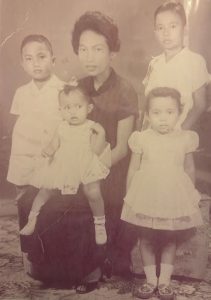
My mother as a young widow, with her four children
My mother, widowed at a young age, is shown in an old photo hanging on the wall of my apartment in Vienna, with her four kids—the eldest, eight years old, and the youngest, three months old. This family picture was obviously taken in a photo studio some time after my father’s death; Mom was still wearing a black dress. We didn’t have any family photo with Father in it. And I used to wonder why my parents didn’t have a wedding photo—I’d never seen one, and it never occurred to me to ask my mom why.
Why would you run away? I was already a young man when I asked Mother if Father was her only lover. She laughed, shooed me away, and told me to stop asking silly questions. I could have asked my father, but I was barely seven years old when he died. Soon, I was an adolescent, adapting to the disorienting challenges of growing up, and I completely forgot to ask the many questions about how my parents ended up together.
According to my aunt, my father was courting her, but when she rejected him, he told her he would be part of her family anyway. My aunt did not realize that my father had the intention – or the plan – to turn his attention to my mother, hence my mom running away with him. My grandfather, although disappointed with what my parents had done, asked my aunt to make a wedding dress for his youngest daughter, and have it sent to my father’s house. He wanted to be sure that his daughter would shine on her wedding day, and that would only happen if she wore a wedding gown tailored-made for her by my aunt.
My father built a house for my mother and his growing family near my grandfather’s house, where we spent our childhood. After my father’s death, Grandfather decided it was best for my mom and her young children to stay with him in his house. My mother never worked in her young life; she was the youngest of six children and was Papa’s girl. With Father gone, Grandfather had his youngest back in his house to care for and pamper. Also living in the house were his only son—a widower—and his two young children, both girls, Nora and Aurora, who I thought were my sisters because they were there throughout my childhood. It was no issue for my grandfather that his only son, Trinidad, widowed at a young age, was staying in the same house. Same with Francisca—Nana Kikay, or Kikang to us—his other unmarried daughter, one of my mom’s older sisters, who helped my mom take care of us, her nephews and nieces. Nana Kikay was especially fond of my elder brother and treated him like her own child. You see, my brother was her first nephew, born in Grandfather’s house, and she helped raise him. Mother and Nana Kikay were close. Not that they weren’t close with their other sisters, but Mom and Nana Kikay had a special bond. Mom adored her other siblings, but Nana Kikay had a special place in Mom’s heart. They spent a lot of time together in the house, day in and day out, and that was the simple explanation I could think of for their special bond. It could also be that Nana Kikay was a grown-up girl already, maybe ten years old, when their own mother died and felt responsible for my mom, who was practically just a baby.
Nana Kikay did most of the household stuff—marketing, cooking, laundry, and cleaning. I would wake up in the morning and find her in the kitchen, busy making breakfast, while holding my brother, who was maybe six years old—his legs around her waist. That was a routine I would see every morning. My brother would whine when he got out of bed, and Nana Kikay would pick him up. I envied the attention he got, but I couldn’t bring myself to whine when I woke up.
Everybody loved Nana Kikay was a favorite aunt because she was kind and always around us children. She was like a nanny to us—she bathed us, read stories from Komiks and magazines, and prepared snacks when we woke up from our afternoon siestas. She was a jolly-good fella and never seemed to have a bad day, with a smile on her face every waking moment. We loved it when she would give us hot am in a bowl with a bit of sugar to sweeten it. Am is that starchy liquid from cooked rice. When cooking rice, Nana Kikay would add extra water to the pot. When it boiled, she would scoop the extra liquid into a bowl for us, her ward, because she knew we loved it, while leaving enough in the pot for the rice to cook completely. It would be the same ceremony each time she made green mung beans for lunch. Before she sautéed the mung beans into a finished dish, Nana Kikay would set aside a bowl of piping hot “mongo” for each of us kids, add sugar and milk, and that would be our special treat, our merienda, and we loved it. Oh, how I missed the days.
Nana Kikay raised ducks in our backyard—to make caldereta for the New Year. She could not cut off the head of a live duck, though. That was a job she let my brother and me do. We were like the guillotine man. I would hold the duck’s head, its neck stretched over a large piece of timber, while my brother beheaded it with one sharp, precise strike. The poor bird would run in all directions, and we watched it in awe until it dropped dead. That was a time in my childhood I wasn’t proud of now and would rather not remember.
She was a kind woman, Nana Kikay, but you wouldn’t want to cross her if you provoked her. I remember that incident when a primary school teacher hurled a blackboard eraser at one of her nephews, hitting him on the head. The impact left a nasty mark on his face. Learning about what happened, Nana Kikay rushed to the school to confront the teacher. Fuming mad, she challenged the teacher to come out of the classroom. No confrontation took place because the teacher was frightened to face Nana Kikay. To get home, the teacher had no choice but to walk past our house. She’d been told that Nana Kikay was on the street in front of our house, waiting for her. Eventually, the school principal had to escort the teacher home, but only after begging Nana Kikay’s forgiveness.
I tried not to upset her at all because I knew how she would react if I did—not with corporal punishment, but with a lengthy sermon. I remember the time I had to go to the toilet when I was maybe seven or eight. The toilet was connected to our house by a bridge made from round bamboo slats. Nana Kikay used this bridge to line up her white laundry—still soaking in soap suds—for the sun to bleach and make it shine whiter. This was the scenario when I had to go to the toilet; I couldn’t walk over the laundry. I had to sprint to avoid stepping on them. Doing so, I hit my forehead on a sharp node of the bamboo bridge railing, wounding me and making me bleed. To avoid being scolded by Nana Kikay, I went to bed and pretended to be asleep. I said I had no idea how I got wounded when Nana Kikay saw me bleeding and asked what had happened. She burst into laughter when she heard me, though I could tell I worried her. She attended to my wound, and contrary to what I had expected, I never got scolded. Instead, she made salabat for me—a traditional Filipino ginger tea. As a child, I hated the strong taste of ginger in my salabat, so to help us children appreciate the tea, Nana Kikay would add sweet potato when preparing it.
Nana Kikay suffered a massive heart attack while watching my brother’s elementary school graduation day. Tears filled her eyes when they found her slouched in her chair. She was the only one in the family who could attend my brother’s graduation, as the other family members were at a cousin’s high school graduation. My mother had to stay home to look after my baby sisters. Nana Kikay loved and considered my brother as her son, and she must have been overwhelmed by mixed emotions of happiness and sadness; happy to see her favorite ward finish elementary school, and sad remembering that my brother was growing up without our father to guide him.
She survived the stroke, which left her half-paralyzed, until her death a year later. Her demise had been a big blow to my brother, who was becoming a teenager then. He became withdrawn and hostile; he had problems in school and got into fights. From the fun boy he once was, he became a problem teen. No one ever thought he might need professional help. But that was in the 60s when behavior like my brother’s was never considered a big deal—at least not in my family. Lilipas din yan (that will pass), people say. It was just an adolescent phase. No one ever thought he might have been longing for Nana Kikay—his “other” mom —since he was born. My mom may have given birth to him, but Nana Kikay still took charge of him as if he were her own child—which Mother didn’t mind, I guess, because her cup was full from raising three other children. Eventually, my brother survived the challenges of teenage life, became a responsible adult, and raised a family of his own. He died in 1999 at the age of 52. Brain tumor. Throughout his life, he remained a devoted son and was convinced until his dying day that he had been so lucky to have been brought up by two mothers.
Or three, counting our Nana Piring, Iyeng to everyone. She was our aunt who couldn’t say no to my father’s request before he breathed his last: to take his place when he was gone. She kept her promise, gave us a home, fed and clothed us, and sent us to school to get an education our mother could not provide on her own.
She accomplished that? She was a dressmaker and had her own atelier. She was 14 years old, my aunt, when she got her first sewing machine and started making dresses, school uniforms, graduation dresses, and ball and wedding gowns for all sorts of parties and people getting married. She was an excellent dressmaker with a large clientele who wanted nothing less than her creations. I remember Christmas Eve, when clients would still be waiting for a dress they wanted to wear on Christmas Day.
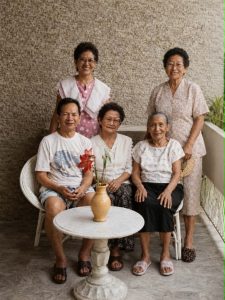
Mom’s family. Standing from left: Nana Piring and Mom. Seated from right: Mom’s only brother and 2 other sisters. Not in pic is Nana Kikay
Nana Piring, Iyeng to many of us, was my mom’s elder sister. She was the 6th of seven kids; my mother was the youngest. She and Nana Kikay never married. They had only one brother, who was widowed at a young age, with two daughters, Toya and Nora, who also lived in the same house where we lived after my father died.
My aunt became Toya and Nora’s surrogate mother when their mother died. At the time, they were three and one years old, respectively. My aunt doted on them and was dedicated to them as a birth mother would. The story goes that on her deathbed, the mother of my two cousins asked my aunt a favor—if she would take care of her daughters while she was away forever. My uncle was still young, and she knew that one day he would find someone to take her place as a wife, but as a mother? She was worried. Nana Piring promised she would, and she kept it until her dying day. Nora, the youngest of the two girls, knew no other mother but our Nana Piring; together, they were the image of Mother Mary and child. Poor Nana Piring; fate had it that years later, another dying person would make her promise to take care of his children. She remained single for the rest of her life, although she had many suitors and could have married the love of her life.
Nana Piring, my aunt, was beautiful and elegant, even in her older years. As a young lass, she had many suitors; the whole village and neighboring towns seemed to know, but her heart belonged to one man only—her first and last boyfriend. There were talks of marriage. They had a photo album with the front cover painted in watercolor with the title “Halina sa Ating Bukas “(Welcome to our Tomorrow). The lover was a commercial artist. I never met the man. I was still a young child, so I couldn’t recall if I ever did. I remember their story, though, and their photo album was the only tangible thing left. A bittersweet story I heard over and over again. No wedding bells tolled for them, but she kept the photo album, with all his photos detached but hers. Where there were pictures of them together, she cut him out. I could imagine her fury as she destroyed all his photos. “I hate you, and I hate you! Were tears falling from her eyes, maybe? I asked, teasing. “No way!” The photo album still exists, hidden in the family baul (wooden trunk) in our old house, together with other photo memorabilia.
His name was Oscar. My aunt’s face would light up at the mere mention of his name, but she denied feeling anything for him. I remember my aunt visiting Baclaran Church every first Wednesday of the month. She was a devout Catholic, a devotee of the Mother of Perpetual Help enshrined in Baclaran Church, so she visited every first Wednesday of the month. Baclaran is a city in southern Metro Manila. I learned the truth behind the mystery of the First Wednesday of the month visit when I finished college: she was imploring the Mother of Perpetual Help to make her forget Oscar forever, and that their paths may never cross again.
She didn’t get a higher education, my aunt; thus, she instilled in us, her nephews and nieces, whose education she supported, the importance and value of a college degree. I hope we didn’t disappoint. She saw us earn degrees in Teaching, Journalism, Dentistry, Priesthood, Economics, Engineering, Library Science, Radio and TV Technology, and a certificate in Hair Science & Cosmetology. She took pride in our achievements and had our graduation photos framed and hung prominently on the wall in the family living room for everyone to see and admire. I had since pulled them down. I didn’t dare tell her that the pictures on the wall reminded me of a Chinese mausoleum. She would have wanted at least one of us to be interested in learning her profession, but no one was, which she didn’t mind. It was a sad day when she closed her shop and chose to design and sew dresses or gowns exclusively for friends and family members, such as her grandnieces, whom she dressed for their baptisms and then their weddings.
Nana Kikay has been gone for many years now; she died in 1959, Nana Piring in 2002, and my mom in 2004. I miss all of them every day. They had been good mothers to all of us, their family. Nana Piring’s first-ever sewing machine is displayed in my living room back home. It is there to stay for many generations to come, old, battered, and tired maybe. Still, it will always remind me, and those who benefited from it, of the many sacrifices she made so that we, her nephews and nieces, and her extended family, get that better edge in life. We are thankful for the unconditional love and generosity she gave us and those whose lives she touched.
Long live our three mothers!